Stage
TANK

Blog
STAGE TANK
Stage Bottles in Diving: Definition, Configuration, and Technical Use
A stage bottle configuration shifts away from the conventional image of a recreational diver with a single tank on their back. However, with the rise of technical diving, the need to achieve greater depths and extended bottom times driven the development of new equipment, techniques, and procedures.
The Challenge of Gas Supply at Depth
Using stage bottles solves the primary obstacle faced by extended-range divers: gas supply duration.
In open-circuit diving, exhaled gas is lost directly into the water, and consumption increases proportionally to depth due to ambient pressure. For instance, at a depth of 10 meters (33 feet), the pressure doubles compared to sea level. This means twice as much gas is consumed with every breath, drastically reducing dive time as depth increases.
To overcome this limitation, the first option is to increase the gas volume carried on the back:
- Single Tank: Upgrading from a standard 12-liter (80 cu ft) cylinder to 15, 18, or even 20-liter sizes. A 15-liter tank offers 25% more gas than a 12-liter one. However, relying on a single cylinder for demanding dives is risky; in the event of a failure or leak, there is no redundant system, leaving the diver entirely dependent on their buddy.
- Doubles / Twinset: To mitigate this risk and improve comfort, double-tank systems were designed (the most common being 2x12 liters, equivalent to a 24-liter single tank). This configuration features an isolation manifold. In an emergency, it allows the diver to isolate the malfunctioning cylinder and conserve the gas in the other, keeping at least one regulator fully operational. Larger twinsets exist (up to 2x20 liters), but their extreme weight makes them difficult to manage both in and out of the water.
When the demands of a dive exceed the capacity of a twinset, stage bottles become necessary.
Stage Bottle Configuration and Advantages
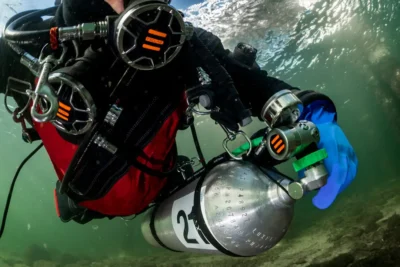
Generally, stage bottles are made of aluminum (most commonly the S80 model, approximately 11.1 liters / 80 cu ft). This material is preferred because, as the gas is depleted, aluminum maintains nearly neutral buoyancy underwater, unlike steel, which remains significantly heavier.
Their configuration includes a rigging kit with two bolt snaps: one positioned near the neck of the bottle and another roughly one-third up from the base. This provides two secure attachment points to clip the bottle onto the chest and waist D-rings of the diver's harness.
This side-slung layout offers major operational advantages:
- Accessibility: It allows the diver to easily monitor and manipulate the tank valve and regulator.
- Flexibility (Drop Points): Divers can unclip and leave the stage bottle on a guideline (e.g., at a cave or wreck entrance) to streamline their profile before entering tight spaces, retrieving it on the way back out.
- Emergency Management: The design allows for a quick and straightforward handover to a buddy experiencing a gas failure.
Gas Management Procedures
Gas planning with stage bottles varies depending on training and environment:
- The Rule of Thirds in Caves: One-third of the stage bottle is consumed during penetration, at which point it is dropped on the line. The team continues moving forward breathing from their twinset until one-third of that supply is used. On the return journey, the second third of the twinset is consumed, and after retrieving the stage bottle, its second third is breathed. Consequently, the diver exits the dive with an emergency reserve of one-third intact in every cylinder.
- The "Half Plus 15 Bar" Procedure: The diver breathes from the stage bottle until half its pressure plus 15 bar (approx. 200 psi) is consumed, then switches to a quarter of the twinset. This method prioritizes retaining as much gas as possible in the twinset—where gas sharing via a long hose is highly viable during emergencies—since a standard stage bottle is not configured to supply two divers simultaneously.
To master these advanced techniques, specialized training through internationally recognized certification agencies such as IANTD, TDI, or PADI (Tec Rec) is absolutely essential.
Stage Bottles vs. Decompression Bottles
There is frequent confusion between these two terms because they share the exact same physical and rigging setup. However, their operational purposes are entirely opposite:
- Stage Bottle: Filled with the same bottom gas. Its purpose is to be consumed first to extend bottom time before switching to the back gas.
- Decompression Bottle (Deco Tank): Filled with oxygen-enriched mixtures (such as Nitrox 50 or pure Oxygen). Its purpose is purely physiological: it is used exclusively during ascent to accelerate nitrogen elimination from the body.